

Virtual consultations are now a routine part of healthcare, particularly in community health. But are these services delivering real value? My research on virtual consultation adoption highlights key factors influencing their continued use. A structured approach to assessing maturity can help organisations refine their services and maximise benefits for both clinicians and patients.
Understanding Maturity in Virtual Consultations
Maturity in this context refers to how well virtual consultations are embedded into routine care, their efficiency, and whether they meet the needs of both clinicians and patients. Assessing the maturity of a service can identify strengths and gaps, ensuring continued improvement. This framework provides a practical way to evaluate progress based on common challenges and best practices.
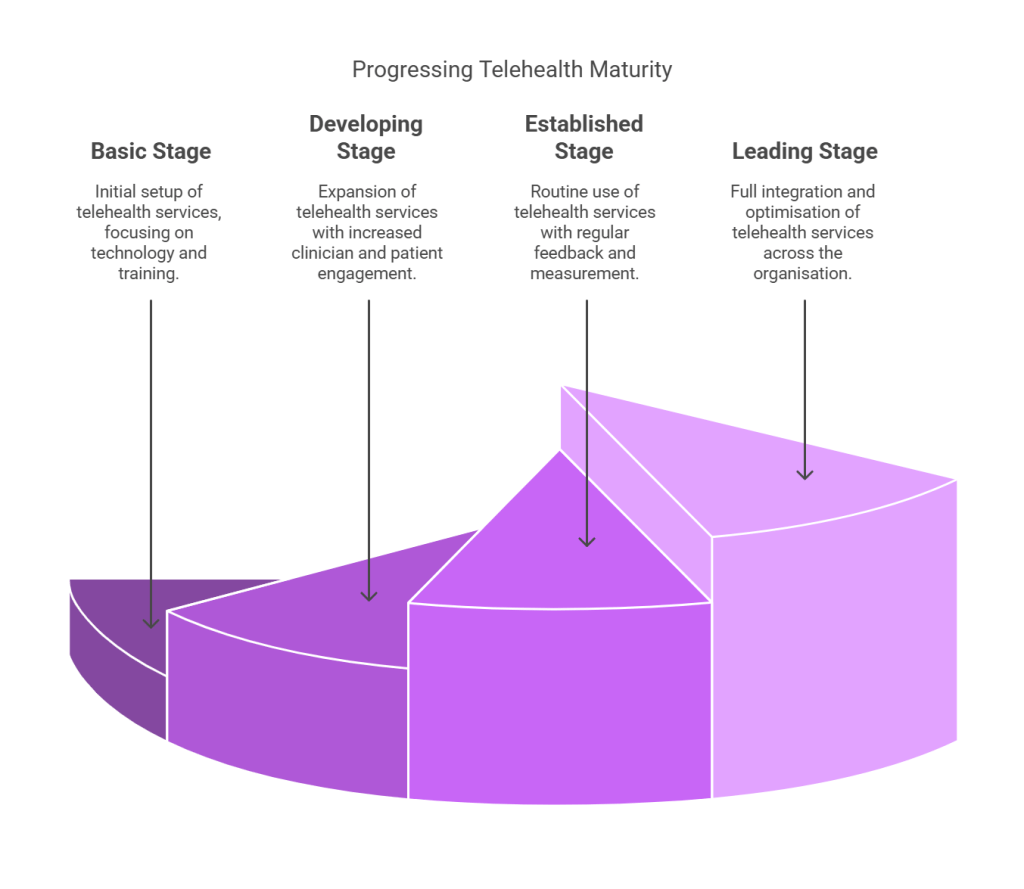
1: Basic Stage – Getting Started
At this stage, virtual consultations exist but are inconsistent and underdeveloped. Technology is limited, with poor integration into existing clinical systems. Some staff have received training, but there is no structured programme in place. Only a small number of clinicians use virtual consultations, and many patients struggle with setup or accessibility barriers. There is no formal tracking of usage, satisfaction, or technical performance.
Common challenges at this stage include unreliable technology, lack of confidence among clinicians, and patient difficulties with setup. To progress, organisations should invest in reliable hardware, ensure integration with their clinical systems, provide clear and practical training for both clinicians and administrative staff, and begin tracking virtual consultation usage while collecting feedback from staff and patients.
2: Developing Stage – Expanding Use
At this stage, virtual consultations are more widely used, but challenges remain. System integration has improved, though occasional reliability issues persist. Formal training is available, but not all staff have adopted it. More clinicians are becoming comfortable with virtual consultations, and patients are gaining familiarity with the process. Basic data is collected, including appointment completion rates and patient satisfaction.
Challenges include variation in usage across different services, technical issues affecting consultation quality, and resistance from some staff or patients. To progress, organisations should standardise training, provide ongoing support, identify services where virtual consultations are most effective, encourage wider adoption, and monitor technical issues to implement necessary improvements.
3: Established Stage – Routine Use
At this stage, virtual consultations are embedded into normal practice and used efficiently across multiple services. Systems are stable, with full integration into patient records, and staff receive regular training with easily accessible guidance. Most clinicians and patients use virtual consultations confidently where appropriate. Key metrics, including DNA rates (no-show), clinician satisfaction, and patient outcomes, are regularly analysed.
Challenges include keeping up with new technology and system updates, ensuring high-quality consultations across all specialties, and addressing digital exclusion for some patient groups. To progress, organisations should use data insights to refine service quality and patient experience, explore the expansion of virtual consultations into new areas of care, and maintain continuous training and support to uphold high standards.
4: Leading Stage – Full Integration and Optimisation
At this point, virtual consultations are a core component of service delivery, fully optimised for efficiency and patient care. Systems are fully integrated with clinical systems, with minimal technical issues. Ongoing education and training ensure staff stay up to date with the latest developments. Virtual consultations are widely used across most services, with high levels of satisfaction among clinicians and patients. Continuous improvement is driven by comprehensive data analysis.
Challenges include keeping staff engaged with ongoing training, adapting to policy changes and funding models, and scaling digital services while maintaining patient-centred care. To sustain this level, organisations should continuously refine processes based on real-world data, share best practices across organisations, and remain adaptable to future healthcare needs.
Where Does Your Service Stand?
Assessing the maturity of a virtual consultation service can help identify gaps and areas for improvement. My research shows that when training, usability, and clinical integration are prioritised, clinicians are more likely to continue using virtual consultations, benefiting both staff and patients.
By understanding the current maturity level and taking steps to advance, healthcare providers can build a more effective, sustainable virtual consultation model that truly meets the needs of clinicians and patients alike.

 Virtual Health Hub