

In just a few years, telehealth has moved from being a crisis-driven stopgap to an integral part of how care is delivered. What started as a workaround during the COVID-19 pandemic has now become a baseline expectation — for patients, clinicians, and healthcare providers alike.
But while many organisations rolled out virtual care services with impressive speed, the question now isn’t how quickly you launched. It’s how sustainably you operate.
The policy gap in digital health
But despite widespread adoption, many providers are operating without a proper telehealth policy, but still working off hastily created documents written in the thick of the pandemic. These often amount to brief compliance checklists or vague strategy outlines, created with good intentions but little foresight. What’s needed now is a mature, actionable telehealth policy — one that aligns clinical protocols, scheduling processes, IT governance, and staff training into a cohesive operational framework.
The difference is critical. A working policy turns telehealth from an improvised service into a reliable, scalable care delivery system.
From Patchwork to Policy: The Case for Structure
Many healthcare organisations adopted telehealth reactively. With speed came compromise. Clinicians used whatever tech was available. Admin staff juggled scheduling inconsistencies. IT teams patched together platforms.
While this adaptability kept services running, it also revealed cracks. An NHS Confederation report noted that without proper governance, digital services often operated in silos, leading to inconsistent clinical practice and variable patient experience (NHS Confederation).
Contrast that with providers who invested in a clear telehealth policy. The difference? Clarity, coordination, and confidence. These organisations saw fewer tech failures, smoother workflows, and higher satisfaction among both staff and patients (Greenhalgh et al., 2020).
The Hidden Costs of Policy Gaps
Without an intentional policy, virtual care becomes a guessing game. Providers don’t always know when a remote consultation is appropriate. Admin teams don’t know what to offer patients. Compliance teams are left to clean up the mess when privacy rules are overlooked.
In research I’ve conducted with clinicians in community healthcare, one theme stood out: uncertainty. Clinicians wanted to use telehealth but weren’t always sure when or how. Inconsistent support, fragmented training, and unclear expectations led many to default back to face-to-face — even when remote care could have sufficed.
It’s not just an operational issue. The risk of clinical error, consent mismanagement, or data breach rises when workflows aren’t standardised. As virtual care becomes a staple, ad-hoc systems are no longer fit for purpose.
Policy as a Strategic Tool — Not a Paper Exercise
The best telehealth policies don’t sit in a binder. They inform how care is delivered, supported, and evaluated. Done well, policy becomes a leadership tool — setting the tone for professionalism, driving cross-team alignment, and offering a framework for continuous improvement.
A strong telehealth policy supports:
- Consistent patient experience, regardless of clinician or service area
- Clear escalation routes when virtual care isn’t suitable
- Training and onboarding that integrates digital health standards
- Reliable reporting on what’s working — and what isn’t
This isn’t about bureaucracy. It’s about giving people the tools, guardrails, and confidence to deliver great care, wherever the patient is.
What Should a Telehealth Policy Include?
There’s no one-size-fits-all. But based on peer-reviewed guidance and real-world examples, effective telehealth policies tend to cover six critical areas.
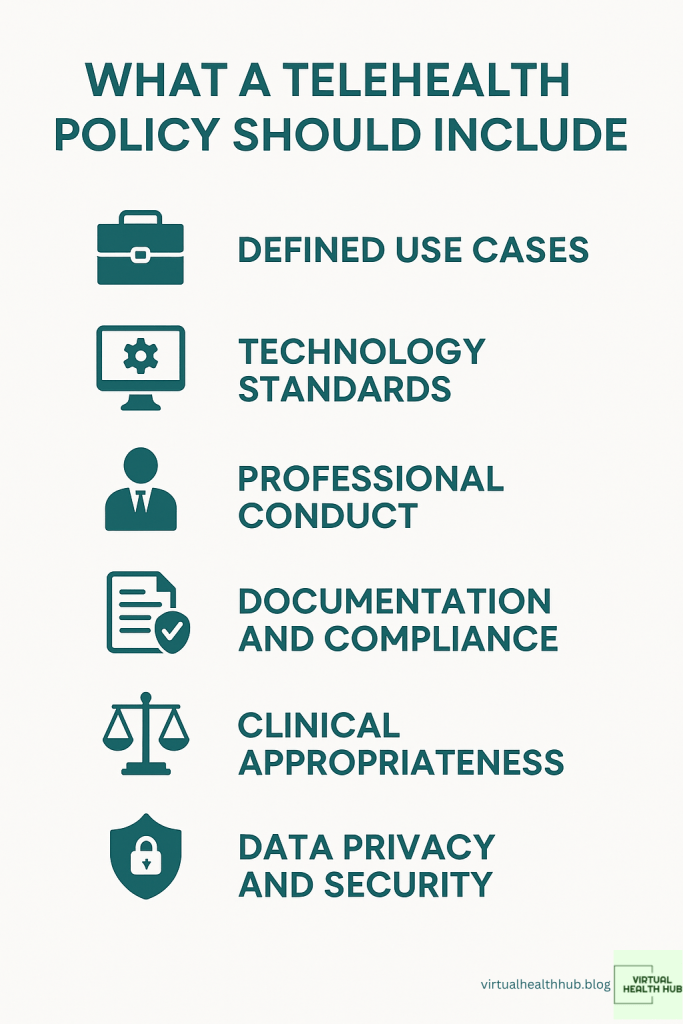
Professionalism and Presence
Patients still judge virtual care on the same standards as in-person. Clear expectations on environment, dress code, and webside manner help ensure trust. One NHS trust introduced a checklist covering background, lighting, and noise levels — not to control clinicians, but to support them in presenting professionally.
Informed Consent
Consent isn’t just a form. It’s a conversation. Verbal consent at the start of a virtual consult reinforces trust and ensures patients understand the format. Embedding phrases like “verbal consent obtained for today’s remote healthcare visit” into documentation templates supports consistency.
Technology Standards
A policy should name approved platforms and clarify fallback procedures (e.g. switching to phone after tech failure). It should also outline how to secure personal devices — a key risk area, especially in community care settings.
Clinical Appropriateness
Not every appointment belongs on video. A telehealth policy should define what types of visits are suitable for remote care — and when escalation to in-person or urgent care is needed. For example, mental health reviews may work well online; safeguarding assessments, less so.
Licensure and Legal Considerations
Although the UK has a more unified health licensing system than, say, the US, scope of practice and indemnity cover for virtual care still matter. Policies should clarify what clinicians can and can’t do remotely, and how cross-border patients (e.g. in devolved nations) are handled.
Data Privacy and Information Governance
With increasing scrutiny around data use, privacy standards must be explicit. Clinicians should know how consent is recorded, where data is stored, and how to manage breaches. Guidance from NHSX (now part of NHS England Transformation Directorate) continues to evolve — and your policy should evolve with it (NHS England).
Telehealth as a Modality, Not a Service
One mindset shift can make or break your telehealth strategy: it’s not a standalone product. It’s a mode of delivering care.
A good telehealth policy embeds digital delivery into existing clinical pathways, operational workflows, and training materials. It’s not something extra — it’s how healthcare works now. From scheduling software to safeguarding protocols, virtual care must be part of the whole, not an optional bolt-on.
And while leadership sets the tone, success lies in co-creation. Engaging front-line staff in writing and reviewing policy ensures it reflects clinical realities — not just theoretical ideals.
What the Research Tells Us
The literature is catching up to practice. Studies increasingly show that when virtual care is supported by strong governance, outcomes are better. A systematic review found that telehealth services with clear policy backing reported better clinician adoption, lower no-show rates, and higher patient satisfaction.
In the UK context, my ongoing doctoral research in community health settings highlights that clear policies reduce variability and support clinician confidence — especially for new or less digitally fluent staff.
And as new technologies such as AI triage tools, remote monitoring, and asynchronous messaging mature, policies will need to adapt. A static document won’t cut it. It needs to evolve, just as care does.
Making Policy Work in Practice
This is the first in a three-part series exploring how healthcare providers can design, embed, and maintain telehealth policies that do more than sit on a shelf.
We’ll next explore how to write a practical, real-world telehealth policy — with examples from across the NHS and beyond. After that, we’ll dive into how to bring it to life: from training and culture change to feedback loops and audit tools.
One thing is clear: telehealth isn’t going away. And neither are the challenges that come with it. But with the right policy, you can move from firefighting to forward planning — and deliver care that’s not just virtual, but valuable.


This is such a timely and insightful post. Having a clear, well-structured telehealth policy is often overlooked, but it’s crucial for ensuring safe, consistent, and equitable care. Thanks for breaking down the key components so clearly—I’ll definitely be sharing this with my team.
LikeLike